

Okay, let’s just dive in, because honestly, this topic trips people up way more than it should. A financial health score is basically a number, or sometimes a short label, that tries to sum up how well your money life is going. Not just your bank balance on a random Tuesday, but the whole picture, income, spending, debt, savings, all mashed together into something you can glance at and go “oh, that’s where I stand.” Kind of like a report card, except nobody’s grading you on attendance.
Why People Even Bother with ThisWhy People Even Bother With This
Here’s the thing though, numbers like this exist because most of us are terrible at seeing our own finances clearly. You know how it goes. You feel fine because your checking account isn’t empty, but meanwhile you’re carrying debt that’s quietly eating your future paycheck. A financial health score cut through that fog a little.
It’s Not Just One Number Pretending to Be Simple It’s Not Just One Number Pretending to Be Simple
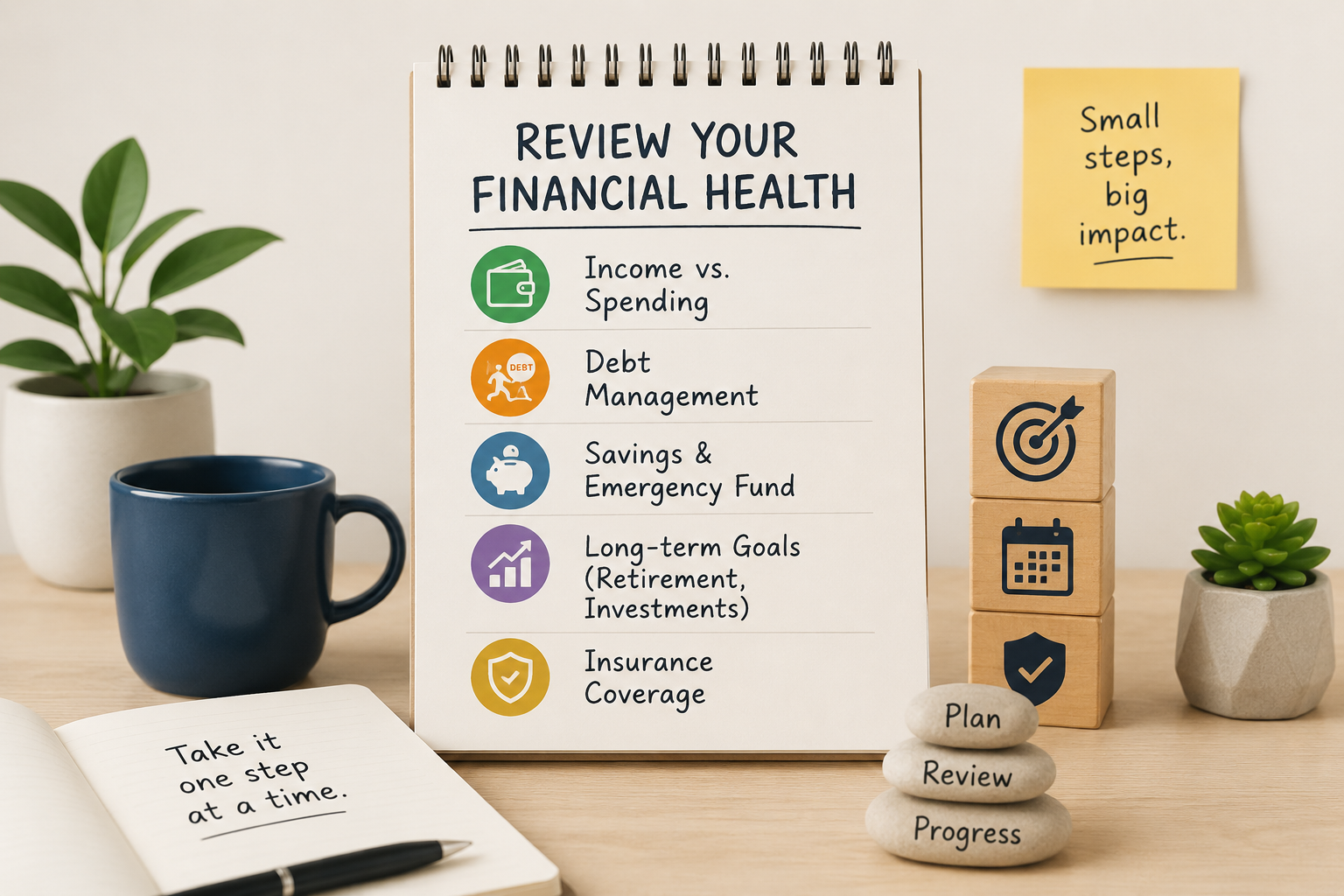
Now, here’s where it gets a bit messy, in a good way. This score usually pulls from several ingredients: how much you’re saving compared to what you earn, whether your debt load is manageable, how consistent your income is, and whether you’ve got any kind of safety net for emergencies.
Some models toss in insurance coverage too. Others look at retirement contributions. It’s less like a single ingredient and more like a stew, everything simmers together until you get one digestible result.
Hold On, Let Me Compare This to Something Familiar
Think about a car dashboard for a second. You’ve got fuel level, engine temperature, tire pressure warnings, all separate readings, but together they tell you whether the car is in good shape to drive across the country or whether it’s going to break down at the next gas station.
That’s basically what this scoring idea is trying to do for your finances. It’s not obsessed with one metric; it wants the full dashboard view.
The Emotional Side Nobody Talks About
I’ll be honest, and this comes from watching friends go through it. Numbers like this can hit differently depending on your mood. Get a low score and suddenly you’re spiraling, thinking you’ve failed at adulting. Get a decent one and you might get overconfident, easing off on saving because hey, the score says you’re fine.
Neither reaction is really fair to the tool itself. It’s meant to be a snapshot, not a verdict on your worth as a person, though it sure can feel that way at 11pm while scrolling through an app.
How This Differs from a Credit Score How This Differs From a Credit Score
People mix these up constantly, and honestly, who could blame them. A credit score mostly cares about your borrowing behavior: do you pay your bills on time, how much debt you’re carrying relative to limits, length of credit history. Its laser focused on lending risk.
This other measure, though, zooms out way further. It doesn’t care if a lender trusts you; it cares whether you personally are stable enough to handle a surprise expense without training your savings.
Totally different goals, even though both spit out a number that people treat like a report card, and honestly, mixing the two up leads to some pretty confused conversations at dinner parties.
Where the Numbers Actually Come From
Curious how does anyone even calculate this thing? Well, it varies quite a bit depending on who’s doing the measuring.
Some approaches lean heavily on ratios, debt compared to income, savings compared to expenses, that sort of arithmetic.
Others fold in softer signals too, like, whether you’re contributing to retirement consistently, or whether your insurance situation could survive a real emergency.
There’s no single universal formula everyone agrees on, which honestly bugs some people, but it also means the concept stays flexible enough to fit different life stages.
A twenty-five-year-old renting an apartment shouldn’t be measured the exact same way as someone nearing retirement with a paid off house.
What Actually Moves the Needle
So, what nudges this score up or down? Building an emergency cushion helps a ton, even a small one. Paying down high interest debt matters more than people expect, since it frees up cash flow in the long run.
Consistent saving, even boring, unglamorous, automatic transfers, tends to matter more than any clever investment trick. And weirdly, just tracking your spending, actually looking at where money goes, often improves things without changing a single dollar amount, purely because awareness changes behavior.
Why A Number Beats A Vague Feeling Why a Number Beats a Vague Feeling
Here’s something worth sitting with for a second. Feelings about money lie to us constantly, in both directions.
You might feel broke while sitting on a decent cushion just because a big bill scared you last week, or you might feel comfortable while quietly drowning in minimum payments you’ve stopped noticing.
A concrete score, however rough, cuts through that emotional noise. It’s not perfect, sure; nothing built from a handful of ratios ever fully captures a messy human life, but it’s a lot more reliable than a gut feeling shaped by whatever mood you woke up in.
And that alone makes it worth checking every now and then, even if you roll your eyes at the idea of reducing your whole financial life down to one tidy digit.
A Quick Detour into Myths A Quick Detour into Myths
Let’s bust a few things while we’re here.
Myth one, you need to be rich for a good score.
Nope. Plenty of high earners have terrible scores because they spend everything and save nothing, while modest earners with disciplined habits score way higher.
Myth two, one bad month, ruins everything.
It doesn’t, since most of these scores look at trends over time, not a single snapshot.
Myth is only for people in trouble.
Actually, plenty of financially comfortable folks check their financial health score regularly just to catch blind spots before they become real problems.
Real Talk from Experiences Real Talk From Experience
I remember someone close to me dismissing this whole concept as some kind of gimmick, until they actually sat down and calculated theirs. Turned out their debt-to-income ratio was way worse than they assumed. Purely because they never lined up the numbers side by side.
That one moment of clarity changed how they budgeted for the next two years. Sometimes, you just need the number to smack you awake a little.
Building Better Money Habits Isn’t Complicated Building Better Money Habits Isn’t Complicated
Improving this score, at its core, doesn’t require fancy strategies.
Start small. Track expenses for a month, just to see where things actually go. Build even a tiny cash, cushion; three hundred rupees beats zero every single time.
Chip away at debt using whichever method keeps you motivated, snowball or avalanche, doesn’t matter as much as consistency does.
So, Should You Even Check Yours? So Should You Even Check Yours?
Honestly, yeah. Not obsessively, not every single week like it’s some social media follower count, but every few months feels reasonable.
Think of this whole exercise less like a judgment and more like a mirror.
It just reflects what’s already true, giving you a chance to adjust before small issues snowball into bigger ones.
Nobody enjoys surprises when it comes to money, and this is one of the simplest ways to avoid them.
Wrapping This Up Wrapping This Up, Sort Of
At the end of the day, a financial health score isn’t magic, and it definitely isn’t perfect.
It’s a tool, a rough compass pointing you toward stability rather than away from it. Use it, question it, adjust your habits based on it, but don’t worship it like it’s the final word on your worth.
If there’s one thing worth remembering from all this rambling, it’s that checking your financial health score every so often beats ignoring your finances entirely until something breaks. Give it a look, be honest with yourself, and let that number guide small, steady changes.