

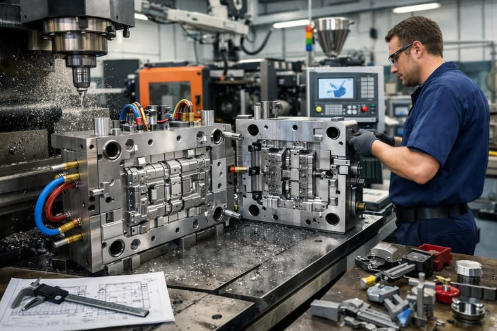
Large scale manufacturing depends heavily on controlling production costs without sacrificing precision. One of the most efficient methods used in modern fabrication is progressive die-based forming processes. In industries like automotive, electronics, and appliance production, cost efficiency is not optional. It is a requirement. Progressive die systems help manufacturers produce complex parts at high speed, with consistent quality and reduced waste. This combination makes them highly valuable for mass production environments where margins are tight and output demands are high.
Progressive Die Metal Stamping Cost Efficiency Drivers
Progressive die metal stamping is a manufacturing process where a metal strip moves through multiple stations in a single die. Each station performs a specific operation such as cutting, bending, or forming until a finished part is produced at the end. This setup eliminates repeated handling and reduces cycle interruptions. The main cost advantage comes from automation and reduced per-part processing time. Once the system is running, it produces parts continuously with minimal manual intervention, lowering operational costs significantly.
Progressive Die Metal Stamping Tooling Investment And Long Term Savings
The tooling required for progressive die metal stamping has a high upfront cost due to precision engineering and die complexity. However, this investment is distributed across large production volumes. In long production runs, the cost per unit drops dramatically. The durability of hardened steel dies also ensures long service life. For manufacturers handling large scale projects, this means substantial long term savings that outweigh the initial tooling expense.
Progressive Die Metal Stamping High Volume Production Efficiency Gains
High volume production is where progressive die systems deliver their strongest advantage. The process runs continuously, with each stroke of the press producing a completed part. This reduces idle time between operations and increases throughput. Compared to single-stage stamping methods, production speed is significantly higher. In large scale projects, this efficiency translates directly into faster order fulfillment and lower production costs per unit, improving overall competitiveness in the market.
Progressive Die Metal Stamping Material Utilization And Waste Reduction
Material efficiency plays a major role in controlling manufacturing costs. Progressive die setups are designed with optimized strip layouts that maximize usable material. Scrap generation is reduced because multiple operations are performed in a controlled sequence within a single die. This precision reduces leftover waste from each sheet of metal. Over large production runs, even small improvements in material usage lead to significant cost savings and better sustainability performance.
Progressive Die Metal Stamping Labor Cost Optimization In Manufacturing
Automation in progressive die systems reduces the need for manual handling at each stage of production. One operator can oversee a machine that performs multiple forming steps automatically. This lowers labor requirements and reduces human error. In large scale manufacturing environments, fewer operators are needed to maintain high output levels. As a result, companies benefit from lower payroll expenses while maintaining consistent production quality and efficiency across shifts.
Conclusion
Progressive die metal stamping offers a strong cost advantage for large scale manufacturing projects. It reduces labor, improves material efficiency, and delivers high speed production with consistent quality. Although tooling costs are high initially, long term savings and scalability make it a highly efficient choice. For industries focused on mass production, it remains one of the most practical and cost effective manufacturing solutions available today.